
Accounting Software for SMEs in Bangladesh: Complete Guide for Growing Businesses
Most small and medium businesses in Bangladesh still run their books on paper registers, WhatsApp voice notes to the accountant, and a spreadsheet someone updates once a week. It works, until it doesn’t. Accounting software for SMEs in Bangladesh solves this by putting sales, purchases, VAT, inventory, and payroll into one system that updates in real time, so the owner knows the actual cash position instead of guessing at it.
This guide walks through why that shift matters for Bangladeshi SMEs specifically, what to look for before buying anything, and where a purpose-built option like accounting software fits into the picture. If you’re comparing this to broader options first, our Account Management Software in Bangladesh guide covers the full category.
Why SMEs in Bangladesh Need Accounting Software
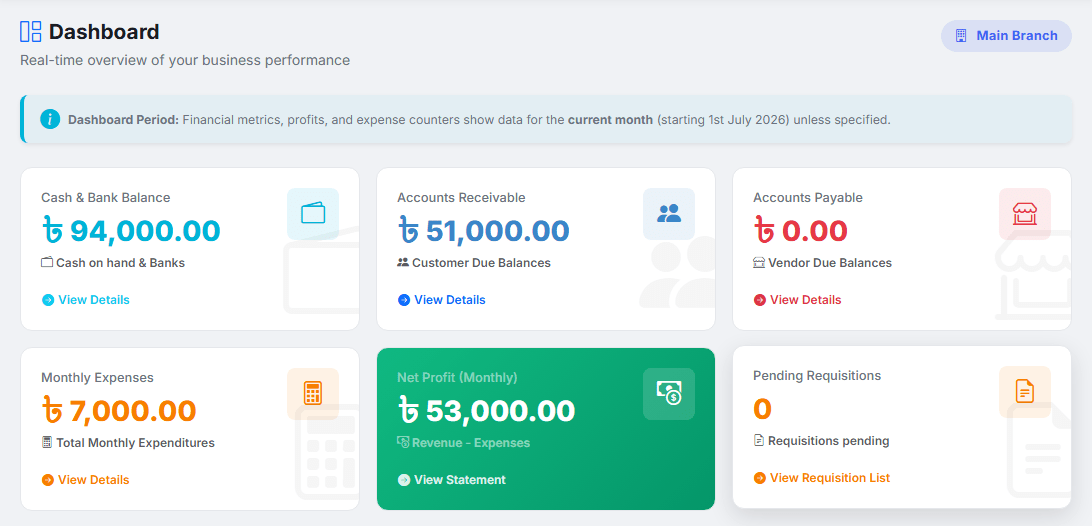
Take a garments accessories supplier in Narayanganj buying zippers and buttons on 30-day credit from three different vendors, while extending 15-day credit to five garment factories downstream. Without a system tracking both sides at once, the owner has no real way to know if this month’s incoming payments will cover next week’s supplier bills. Add VAT invoicing under the VAT and Supplementary Duty Act, a spike in orders before Eid that requires temporary staff on top of the regular team, and a bookkeeper who also handles stock counts and salary disbursement, and the gap between “we’re probably fine” and “we’re actually fine” gets wide fast. That gap is what accounting software is built to close.
Manual bookkeeping breaks down quietly. Sales get recorded late, purchase invoices go missing before month-end reconciliation, and by the time the owner sees a clear profit and loss picture, the quarter is already over. Small business accounting software fixes the timing problem. Every sale, purchase, and expense hits the books the moment it happens, so decisions get made on current numbers instead of last month’s guesswork.
There’s also a compliance angle that’s easy to underestimate. The National Board of Revenue has been pushing SMEs toward electronic VAT filing and Mushak-format documentation for years. Software that generates VAT-compliant invoices and reports on demand removes a recurring source of stress during filing periods.
Common Financial Challenges Faced by SMEs in Bangladesh
Before picking features, it helps to name the actual problems SME owners deal with day to day:
- Cash flow blind spots. Money owed by customers and money owed to suppliers rarely gets tracked in the same place, so owners often can’t answer “how much cash do I actually have right now” without a manual count.
- VAT and tax documentation. Preparing Mushak 6.3 and 9.1 forms manually is slow and error-prone, especially for businesses issuing dozens of invoices a day.
- Inventory mismatches. Stock counts on paper rarely match what’s on the shelf, which leads to overordering, stockouts, or both in the same month.
- Payroll complexity. Once headcount passes ten or fifteen people, working out overtime, leave balances, and provident fund contributions by hand under Bangladesh Labour Act 2006 rules stops being a once-a-month task and starts eating a full week.
- Everything lives in a different place. Sales are in one register, purchases in another, expenses on a phone note or a separate spreadsheet. Closing the books means pulling all of it together by hand, which is why month-end so often slips into the second week of the next month..
None of these are unusual. They’re the standard growing pains for any SME accounting software buyer in this market, and they’re exactly what a proper system is built to remove.
Key Features SMEs Should Look For in Accounting Software
Not every accounting solution for SMEs is built the same way. Here’s what actually matters for a Bangladeshi small business, rather than a generic international checklist.
VAT Accounting Software and Compliance
The system should generate NBR-compliant VAT invoices automatically and produce Mushak-format reports without manual re-entry. This alone can save hours every filing cycle.
Invoicing and Sales Management
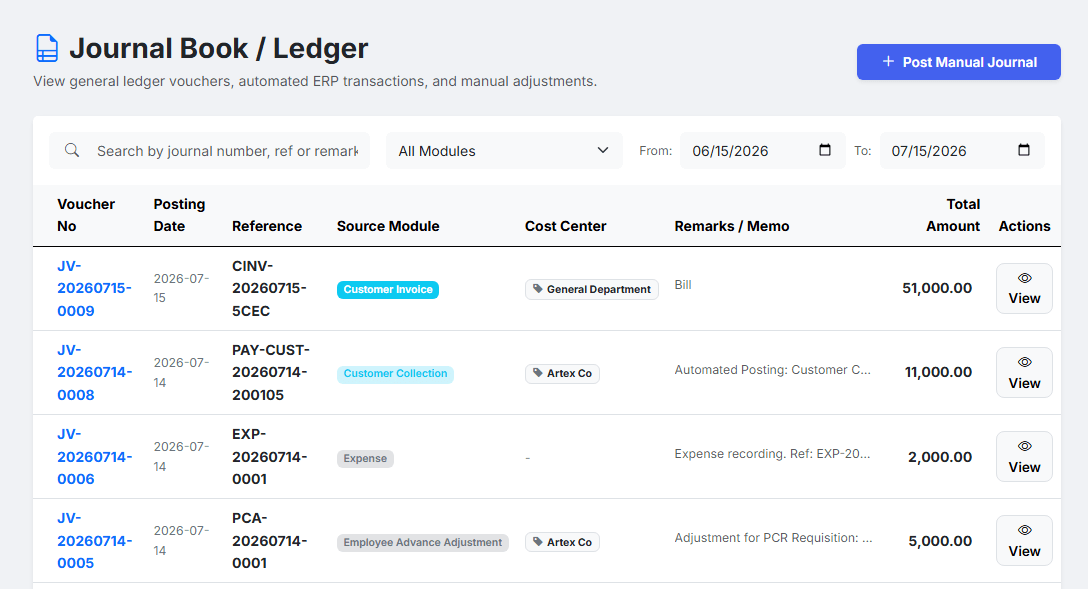
Fast, template-based invoicing that ties directly into sales management and accounts receivable, so an unpaid invoice shows up as a follow-up task, not a forgotten line item.
Purchase Management and Accounts Payable
Tracking what’s owed to suppliers in one place prevents duplicate payments and missed early-payment discounts.
Inventory Accounting Software Features
For retail, wholesale, and manufacturing SMEs, inventory needs to be tied directly to accounting, not managed as a separate spreadsheet. Stock levels, reorder points, and cost of goods sold should update automatically with every sale or purchase.
Cash Flow Management and Bank Reconciliation
Real-time cash flow management, paired with bank reconciliation that matches transactions against bank statements automatically, is what turns “I think we’re okay” into “here’s exactly where we stand.”
Payroll Integration
Payroll integration that accounts for Bangladesh Labour Act 2006 leave and overtime rules removes one of the most error-prone manual processes in any growing SME.
Financial Reports
On-demand financial reports, profit and loss, balance sheet, and cash flow statements, give owners and investors a real picture without waiting on an accountant to compile one manually.
How Accounting Software Saves SMEs Time and Money
The time savings are the easiest to see first. A business issuing 30 to 50 invoices a day can lose several hours weekly to manual data entry and reconciliation. Automating that process frees up that time for actual operations, sales, and customer service.
The money savings are less obvious but often larger. Automated accounts payable tracking catches duplicate or late payments before they happen. Real-time inventory accounting reduces both overstocking, which ties up cash in unsold goods, and stockouts, which lose sales outright. And accurate, current financial reports mean owners catch a margin problem in week two of a bad month, not in month three when it’s already cost real money.
There’s a compliance cost angle too. VAT filing errors and late submissions carry penalties under NBR rules. Software that generates compliant documentation automatically reduces that risk considerably.
Integrating Inventory, Payroll, and VAT in One System
The real value of accounting software for SMEs in Bangladesh isn’t any single feature. It’s having inventory, payroll, and VAT compliance running off the same underlying data instead of three disconnected tools. When a sale happens, inventory updates, the VAT invoice generates automatically, and the revenue reflects in cash flow reports, all from one action instead of three manual entries across three systems. That single-system approach is what separates accounting solutions for SMEs from software that just digitizes a paper ledger.
Why Dusra Soft Accounting Software Is Built for Bangladeshi SMEs
Dusra Soft’s accounting software was built around the actual regulatory and operational environment SMEs in Bangladesh work in, not adapted from a generic international template. That means NBR-aligned VAT invoicing and Mushak reporting out of the box, payroll calculations that follow Bangladesh Labour Act 2006 rules, and inventory tracking designed for the retail, distribution, and manufacturing patterns common among local SMEs.
As a Dhaka-based provider, Dusra Soft also offers local support in Bangla and English, which matters when a VAT filing deadline is two days away and an owner needs a fast answer, not a support ticket routed through a different time zone. For SMEs comparing a full accounting solution against the broader Complete Accounting Software Solution available on the market, that combination of local compliance and local support is the practical differentiator.
FAQs
What is the best accounting software for SMEs in Bangladesh? There’s no single answer that fits every SME, but we can tell you what we prioritized when we built EasyKaj. The biggest complaint we kept hearing from small business owners was inventory and accounting drifting apart, one system saying you have stock, the shelf saying otherwise. That usually happens when software syncs the two on a schedule instead of running them off the same database. EasyKaj doesn’t sync, it just updates both the moment a sale happens, so what’s on paper and what’s on the shelf actually match.
Is cloud accounting software safe for small businesses in Bangladesh? Yes, assuming the provider is doing the basics right: encrypted storage, automated daily backups, and role-based access so not every staff member can see or edit every record. That last part matters more than people think. We set permissions per module by default, so your inventory clerk isn’t looking at payroll data just because they’re logged into the same system.
How much does accounting software for SMEs in Bangladesh cost? This one genuinely varies by how much of the system you need running, whether it’s invoicing alone or invoicing plus inventory plus payroll plus multi-user access. We’d rather quote you a real number based on your actual setup than throw out a range that doesn’t apply to your business. Reach out to Dusra Soft directly and we’ll walk through it. [needs source: specific pricing figures]
Can accounting software handle VAT filing in Bangladesh? Yes, that was one of the first things we built, since it’s the requirement most SMEs get penalized on if it’s handled manually. The system generates Mushak 6.3 and 9.1 formatted output directly from your invoice data, no manual reformatting between what you sold and what NBR wants to see.
Do small businesses really need accounting software, or is a spreadsheet enough? A spreadsheet is fine until two people need to update it at the same time, or until you need last month’s numbers and this month’s numbers to actually reconcile without a manual cross-check. In our experience building for SMEs here, that breaking point usually hits somewhere around the first ten regular invoices a week, or the first employee added to payroll. Past that, the spreadsheet isn’t saving time anymore, it’s just hiding the extra work.
What are the top-rated cloud accounting solutions for small businesses? There’s no single “best” list that holds up across markets, ratings differ a lot between global platforms built for the US or UK and systems built for how Bangladeshi SMEs actually operate, VAT rules included. What we’d tell you to check instead of a star rating: does it run natively in your regulatory environment, or is it a general-purpose tool you’re bending to fit local requirements. EasyKaj falls in the first category, which is a different comparison than ranking it against Western SaaS tools.
Which accounting software is best for managing inventory in a retail SME? For retail specifically, the deciding factor is whether stock updates the moment a sale happens or on a delay. A lot of platforms treat inventory as a bolt-on module that syncs periodically, which is fine until you’re checking stock levels against a number that’s already a few hours stale. We built EasyKaj so a sale hits the ledger and the stock count in the same transaction, which matters more for retail than almost any other feature on the list.
What essential features should I look for in SME accounting software? If we had to narrow it to a short list: native VAT invoicing for your market, inventory and accounting sharing one database instead of syncing, payroll that follows local labour law out of the box, and cloud access so you’re not tied to one machine. Everything else, reporting dashboards, multi-currency, custom templates, is useful but secondary. Get those four right first.
Are there accounting software providers catering specifically to Bangladeshi SMEs? Yes, though the market is smaller than the general SaaS space, so it takes more digging than a quick search suggests. We’re one of them. We built EasyKaj around NBR VAT rules and Bangladesh Labour Act 2006 payroll requirements from day one, rather than adapting an international product after the fact, which is the main thing to check for with any provider claiming to serve this market.
Final Thoughts
Most SMEs don’t switch to accounting software because they read an article about it. They switch after a bad month, a missed VAT deadline, a stock count that didn’t match the shelf, or a payroll calculation that took longer than the actual work it was tracking. If any of that sounds familiar, that’s the signal to stop patching the problem with another spreadsheet tab. EasyKaj by Dusra Soft was built for exactly that point, and we’re happy to walk you through it if you’re there.


