Accounting Software for Super Shops in Bangladesh: Features, Benefits & How It Works
A super shop can generate hundreds of sales in a day without looking particularly complicated from the outside.
A customer picks up a few products. The cashier scans them. The payment is collected. A receipt comes out.
Done.
Not quite.
Behind that short transaction are several pieces of information that the business needs to keep accurate. The sale affects inventory. The payment affects cash or bank balances. The purchase price affects the cost of goods. A return changes both stock and sales records. Supplier purchases affect accounts payable. Expenses affect profit. VAT records need to reflect the underlying transactions.
That is why accounting software for super shops cannot be treated as nothing more than a digital ledger.
It needs to work with the way a retail business actually operates.
For DUSRA Soft, that means looking beyond accounting in isolation. Its software services bring together POS, account management and inventory solutions, while its account-management platform connects invoices, bills, cash, bank accounts, ledgers and financial statements in one system.
This guide explains what that setup looks like, which features matter, how POS and accounting should interact, and what a super shop in Bangladesh should check before choosing a system.
Related guide: For the broader SME accounting picture, see Accounting Software for SMEs in Bangladesh.
What Is Accounting Software for Super Shops?
Accounting software for super shops is a business management system that records and organizes the financial side of retail operations while connecting it with day-to-day sales and inventory activities.
The useful part is not simply having a digital ledger.
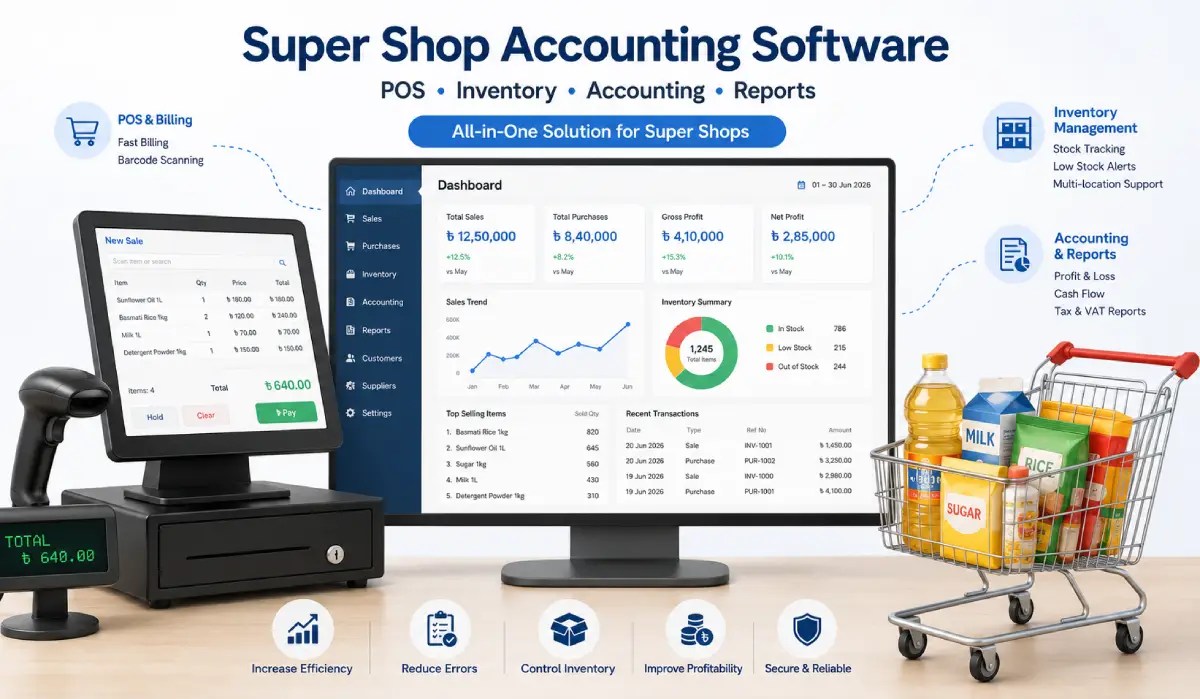
When a cashier scans a product and completes a sale, the system can record the transaction while updating stock and feeding the relevant financial data into the accounting records. That means the accountant is not waiting until the end of the day to recreate sales from printed receipts or handwritten notes.
This is the direction taken by many modern retail systems in Bangladesh. Super-shop solutions commonly combine barcode billing, stock management, purchase and sales records, customer and supplier information, and financial reporting in one platform.
For a small shop with a few products, manual records may survive for a while. A busy super shop is a different story.
Why Super Shops Need Specialized Accounting Software
A normal business sale is only one piece of the accounting puzzle. In a super shop, hundreds or thousands of small transactions can happen in a single day.
One customer buys groceries with cash. Another uses a card. Someone returns an item. A supplier delivers new stock. A product reaches its reorder point. A cashier closes a shift. An expense is paid. A branch transfers products to another branch.
Try keeping all of that in separate spreadsheets.
It gets messy quickly.
Large numbers of daily transactions
Super shops process many individual sales, often involving multiple products per invoice. Recording those transactions manually creates unnecessary work and increases the chance of mistakes.
With integrated accounting software, sales data can be captured from the POS rather than typed into the accounting system again later.
Inventory and accounts need to agree
Imagine the system says a product is worth ৳500,000 in stock, while a physical count shows something very different.
Which number is correct?
That question becomes harder when sales, returns, purchases and stock adjustments are maintained in separate files. DUSRA Soft’s existing SME accounting guidance makes the same point at a broader level: inventory should be tied directly to accounting rather than maintained as a disconnected spreadsheet.
Supplier purchases and payments
Super shops buy from multiple suppliers. Some purchases are paid immediately. Others may be settled later.
Accounting software can keep purchase records connected to supplier balances, making it easier to see what has already been paid and what is still outstanding.
Cash flow becomes easier to understand
Revenue is not the same thing as available cash.
A shop can have strong sales while still facing cash-flow pressure because money is tied up in inventory, supplier payments or customer credit.
A connected accounting system gives the owner a clearer view of what came in, what went out and where the money is tied up.
VAT and financial records
For Bangladeshi businesses, accounting also has a compliance side. The system needs to handle the business’s VAT records and produce the reports and documentation required for its operations.
DUSRA Soft’s SME accounting solution, for example, emphasizes VAT invoicing and Mushak-format reporting as part of its Bangladesh-focused accounting workflow.
How POS, Inventory and Accounting Work Together
This is where a super-shop accounting system becomes much more useful than a digital version of a paper ledger.
Consider a simple transaction.
A customer walks to the checkout with several products.
The cashier scans the barcodes.
The POS creates the invoice.
The payment is recorded.
Inventory is reduced.
The sale enters the accounting records.
The relevant VAT information is captured.
The transaction becomes part of the sales and financial reports.
One sale. One workflow.
That connected approach is already common in the current Bangladesh market, where competing retail systems advertise POS, stock, sales, purchasing and accounting from a shared platform.
The real advantage shows up after hundreds of transactions.
You don’t have to reconstruct the day from receipt copies.
Key Features of Accounting Software for Super Shops
POS and barcode billing
Fast checkout matters in a busy retail environment. A cashier should be able to scan products, apply the correct price and discount, accept the payment and issue a receipt without slowing the queue.
DUSRA Soft already offers POS software for super shops with barcode-based sales, product management, stock tracking and reporting.
For the accounting side, the valuable part is the connection between that POS activity and the financial records.
Inventory accounting
A super shop does not just need to know how many items are left.
It needs to understand the financial value of that stock.
The system should help track stock coming in, stock going out, adjustments, purchases and sales while keeping the related accounting information consistent.
This is especially useful when hundreds of products are moving every day.
Purchase management
Every purchase affects the business financially.
The software should make it possible to record supplier purchases, purchase costs, payments and outstanding balances without forcing the accounts team to rebuild the information manually.
Sales accounting
Sales should move into the accounting records as part of the normal billing workflow.
That reduces duplicate entry and makes daily reporting much faster.
Accounts receivable
Not every retail business operates entirely on cash sales.
Where customer credit or business accounts are involved, the system should show what is outstanding, who owes it and how long it has been outstanding.
Accounts payable
The same logic applies to suppliers.
A clear supplier ledger helps the owner see upcoming payment obligations instead of discovering them when a vendor starts calling.
Expense management
Rent, electricity, salaries, transport, maintenance, software subscriptions, marketing and smaller operating expenses all affect the bottom line.
Recording those expenses properly is necessary for meaningful profit reporting.
VAT and tax-related records
VAT is not something that should be reconstructed after sales are finished.
A system designed for Bangladesh should make the relevant transaction data easier to use for VAT records and reporting. DUSRA Soft’s SME accounting solution specifically positions VAT invoicing and Mushak reporting as part of its local workflow.
Profit and loss reporting
Sales numbers alone can make a shop look successful.
Profit tells the real story.
The software should help the owner understand revenue, cost, expenses and the resulting profit rather than simply showing total sales.
Balance sheet and financial reports
As the business grows, owners need more than a daily sales summary.
Financial reporting can help show assets, liabilities, income, expenses and the overall financial position of the business. Competitor solutions in this category commonly advertise reports such as ledgers, trial balance, income statements and balance sheets.
Multi-branch accounting
This becomes especially valuable when a super shop expands.
Without a centralized system, each branch can end up maintaining separate records that are difficult to compare.
With multi-branch accounting, management can review branch sales, stock movement and financial performance from a more consistent data set.
Super Shop POS Software vs Accounting Software
These two systems are related, but they are not the same thing.
| Function | POS Software | Accounting Software |
|---|---|---|
| Barcode billing | Yes | Usually connected through POS |
| Sales recording | Yes | Yes |
| Inventory tracking | Yes | Yes, when integrated |
| Purchase records | Often | Yes |
| Customer due | Sometimes | Yes |
| Supplier payable | Limited in some systems | Yes |
| General ledger | Usually limited | Yes |
| VAT accounting | May be limited | Yes |
| Profit and loss | Basic sales view | Full financial report |
| Balance sheet | No | Yes |
| Cash-flow reporting | Limited | Yes |
| Financial statements | No or limited | Yes |
The best setup for a growing super shop is often not choosing one and ignoring the other.
It is connecting them.
A cashier needs a fast POS system. The owner and accountant need reliable financial records. The same transaction should serve both purposes instead of being entered twice.
DUSRA Soft already positions its super-shop POS around barcode sales, stock valuation, stock movement and reporting, while its related account-management service handles the financial side.
What Happens When POS and Accounting Are Separate?
At first, separate systems can seem cheaper or easier.
Then the workload starts growing.
Sales are exported from the POS. Someone cleans the data. The accountant enters figures into another system. Inventory numbers are checked against a spreadsheet. Expenses live somewhere else. A mismatch appears.
Now somebody has to find it.
That process wastes time, but the bigger problem is that errors can remain hidden until someone notices them.
An integrated system reduces those handoffs.
The sale is entered once. The related information can then flow through the connected modules.
That is also consistent with the broader accounting approach DUSRA Soft describes for SMEs, where inventory, sales, VAT and financial reporting work from the same underlying transaction data.
Benefits of Using Accounting Software for a Super Shop
The first benefit is speed.
Cashiers can process sales without creating extra accounting work later.
The second is visibility.
An owner can see more than today’s revenue. They can look at purchases, expenses, inventory values, outstanding amounts and financial reports from the same system.
Then there is control.
When different employees handle billing, purchasing, inventory and accounts, user permissions become useful. Each person can work with the information needed for their role without giving everyone unrestricted access to every financial record.
This matters more as a business grows.
And then there is the simple benefit of fewer repeated tasks.
Every piece of information that has to be typed twice is another opportunity for something to go wrong.
How Accounting Software Helps a Growing Super Shop
A small super shop may start with one branch and a few employees.
Then sales increase.
More products are added. More suppliers appear. More cashiers are hired. Maybe a second branch opens.
The old process suddenly feels very different.
A system that worked when the business had a few hundred transactions may become painful when it has several times that volume.
This is why software selection should be based on where the business is heading, not only where it is today.
Look for support for multiple users, inventory, purchasing, financial reporting, role-based access and branch management when those needs are likely to arise.
How to Choose Accounting Software for a Super Shop in Bangladesh
Don’t start with the longest feature list.
Start with your workflow.
Ask what happens from the moment stock arrives at the shop to the moment a customer pays and the sale appears in the financial report.
Then ask how returns are handled.
Ask how supplier payments are recorded.
Ask how stock adjustments affect accounts.
Ask how VAT information is generated.
Ask what happens when another branch is added.
And ask whether your accountant can actually use the system without building another spreadsheet beside it.
A good accounting system should remove work. If the team still has to maintain multiple parallel records every day, something is wrong.
It is also worth checking whether the software is designed for Bangladesh rather than simply translated into English or adapted from another market. VAT workflows, local reporting needs, currency, business practices and support arrangements can all affect the practical usefulness of the system. DUSRA Soft positions its SME accounting software around Bangladesh-specific VAT and payroll requirements and local support.
Who Can Use Super Shop Accounting Software?
This type of software is not limited to large supermarkets.
It can be useful for:
- Super shops
- Grocery stores
- Mini marts
- Convenience stores
- Retail chains
- Departmental stores
- Multi-branch retail businesses
The size of the shop matters less than the complexity of the operation.
A single outlet handling a large product range can have accounting problems that are just as frustrating as those faced by a growing chain.
Accounting Software for Super Shops: A Practical Example
Suppose a super shop purchases 200 units of a product from a supplier.
The purchase is recorded.
The inventory quantity increases.
The purchase value enters the relevant records.
Later, customers buy 35 units.
The POS records those sales.
Stock falls by 35 units.
The sales value enters the accounting records.
The business now has a clearer view of what it sold, what remains in stock and what that activity means financially.
Now imagine repeating this across hundreds of products every day.
That’s why integration matters.
The value is not in having separate modules with fancy names. It is in making the modules work together.
Why DUSRA Soft Can Be a Fit for Super Shops
DUSRA Soft already provides software solutions covering POS, account management and inventory management, which makes the connected approach more practical for businesses that need more than basic bookkeeping. Its POS solution for super shops includes barcode-based sales, stock tracking, multi-shop use and detailed reporting.
For businesses looking at the wider accounting side, DUSRA Soft also has an SME-focused accounting solution covering areas such as invoicing, purchasing, inventory accounting, VAT, cash flow and financial reporting.
That combination matters because a super shop does not operate in separate boxes.
Sales affect inventory.
Inventory affects purchasing.
Purchasing affects accounts payable.
Sales affect revenue.
Expenses affect profit.
VAT depends on the underlying transactions.
Good software should reflect those connections.
Frequently Asked Questions
What is accounting software for super shops?
It is software that manages the accounting side of a super shop while connecting financial records with sales, purchases and inventory activities. Instead of maintaining separate records for each area, the business can work from connected transaction data.
Is accounting software the same as POS software?
No. POS software is mainly focused on sales and checkout operations. Accounting software manages financial records and reporting. For a super shop, integrating both systems is usually more useful than treating them as completely separate tools.
Can accounting software manage super-shop inventory?
Yes, when inventory management is included or integrated. The system can track stock movements, purchases and sales and connect those changes with accounting records.
Can super-shop accounting software support multiple branches?
Many modern retail and ERP systems support multi-branch operations. This allows businesses to manage branch-level sales, stock and financial information from a centralized system. Several current Bangladesh solutions promote multi-branch functionality as part of their retail software offering.
Why should a super shop connect POS with accounting?
Because the same sale affects more than the cash register. It can change inventory, sales revenue, VAT data and financial reports. Connecting the systems reduces repeated data entry and gives management more current information.
Is accounting software useful for a small super shop?
Yes. The need is driven less by company size and more by transaction volume and operational complexity. Once a business has many products, regular purchases, multiple staff members or detailed financial reporting needs, manual bookkeeping becomes harder to maintain.
What should I check before buying accounting software for a super shop?
Check the complete workflow rather than focusing only on individual features. Look at POS integration, inventory, purchasing, accounts payable and receivable, VAT workflows, financial reports, user permissions, branch support, backups, support and ease of use.
Final Takeaway
A super shop does not need accounting software simply because every business is supposed to have accounting software.
It needs it because retail creates a lot of connected financial activity.
A sale changes stock. A purchase changes supplier balances. Expenses reduce profit. VAT depends on transactions. Branches create another layer of reporting.
When those records are scattered across registers, spreadsheets and separate applications, the business spends time putting the pieces back together.
An integrated accounting system changes that.
The goal is simple: enter the transaction once and let the system carry the relevant information through POS, inventory and accounts.
For a growing super shop in Bangladesh, that can make the difference between knowing what happened yesterday and actually knowing how the business is doing today.